How This Country Can Afford Nice Things (And Why No One Is Talking About It)

The purpose of this blog is to talk about ideas that can help you save money. Today I’m going to talk about something the whole country (and by extension, you) could do to achieve that. In the long run, it would save you money by lowering your taxes and using the taxes you already pay to offer some pretty nice benefits.

If you’ve been watching the Democratic debates lately, or been keeping up with the policies of the Democractic candidates, you know how many ideas are floating around that promise to completely change the country: free healthcare, free college, universal basic income, and more. What these all have in common is they’re expensive. So naturally, the question everyone is asking is how can our country afford these things? 


Despite the Republican party being associated with fiscal responsibility, if you actually listen to the Democratic debates you’ll hear a lot more explanations for how things can be paid for (and no, the explanations are not just saying Mexico will pay for it). In some cases, those ways involve raising taxes, but what if I told you that I’ve found a way we could pay for a lot of those ideas by simply moving some money around that is already in our government budget.

What if there was a segment of our government spending that was so outrageous, that re-allocating a fraction of that money would pay for lots of these ideas without hurting the organization we’re taking it away from? I’m talking about our military. Before you get all “wait, he doesn’t support our troops?” of course I do. I appreciate the sacrifices every member of our military makes. In fact, I appreciate them so much I don’t want to see them get hurt. I don’t want them to have to fight, kill, and be killed. So, how much does our military cost us? 

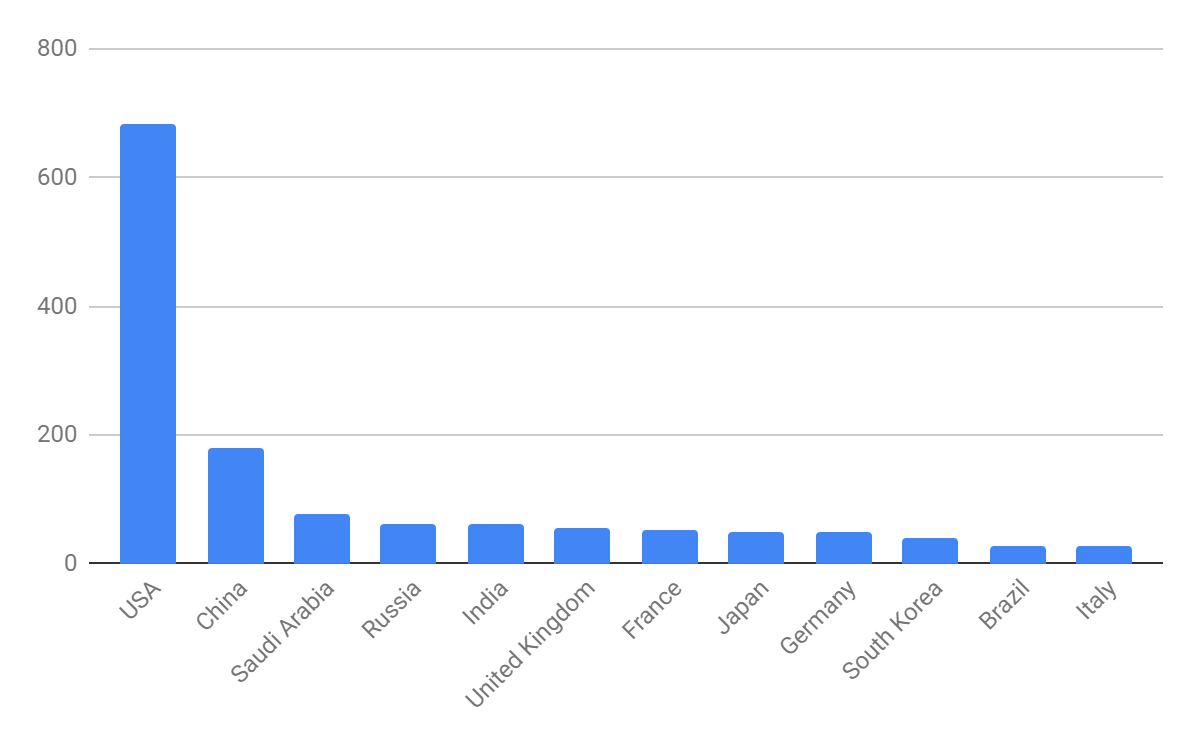
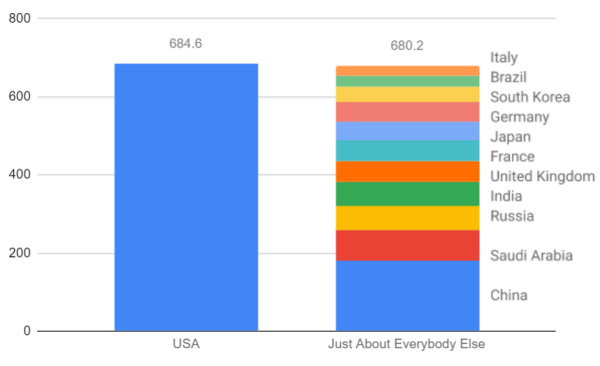
According to the 2020 edition of “The Military Balance” from the International Institute for Strategic Studies, the United States’ defense budget for 2019 was $684.6 billion. Currently we spend well over triple (almost quadruple) what China spends and over 8 times as much as Saudi Arabia. Those are the top two behind us! In fact, if you add up the next 11 highest national defense budgets, it would still be less than that of the United States. We’re talking about China, Saudi Arabia, Russia, India, the United Kingdom, France, Japan, Germany, South Korea, Brazil, and Italy COMBINED. That’s still $4 billion less than the United States spending. Some people may hear this and say hell yeah USA number 1 baby! And while that is a solid argument, I would float the idea that we might be spending an excessive amount of money on our military.

For reference, the top 12 military budgets by country in 2019:

  1. USA: $684.6 billion
  2. China: $181.1 billion
  3. Saudi Arabia: $78.4 billion
  4. Russia: $61.6 billion
  5. India: $60.5 billion
  6. UK: $54.8 billion
  7. France: $52.3 billion
  8. Japan: $48.6 billion
  9. Germany: $48.5 billion
  10. South Korea: $39.8 billion
  11. Brazil: $27.5 billion
  12. Italy: $27.1 billion

Below is the same information in a different graph:
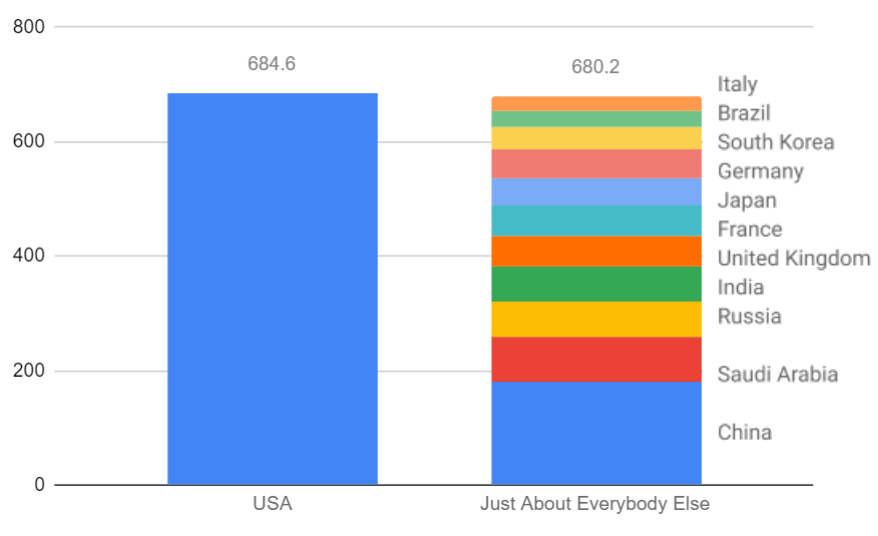
So at the same time everyone is talking about how our country could possibly afford healthcare, social security, education, and other nice things, we’re raising our already astoundingly high military budget without batting an eye. On March 11, 2019, Trump sent Congress a proposed 2020 budget request of $750 billion for national security. The staggering amount of money our country spends on the military only makes sense if A) we’re planning on going to war with pretty much the rest of the world (I hope not) or B) people are getting very rich off that spending. Well, guess what, it’s B.

Companies like Lockheed Martin and Northrup Grumman make tons of money thanks to the United States military spending. In 2014, the CEO of Lockheed Martin made $33.7 million. If you’re wondering why we spend so much on our military compared to other countries, look no further than lobbying and campaign contributions. In 2012, defense contractors spent $132 million lobbying the federal government, and in the 2012 campaign cycle, defense contractors contributed over $27 million to candidates. So that seems to be the cycle. Defense contractors spend money on politicians to convince them to award huge contracts, which means we raise the defense budget, raise taxes, and bleed the American people dry in the name of “supporting our troops”. The politicians enact policies to take our money, they give that money to defense contractors, who spend it lavishly and pay their executives very well, and skim a little off the top to give back to the politicians so they can keep the cycle going. It’s a well-oiled machine. If you’re wondering why we’re constantly at war and why we have such a high defense budget, this might have something to do with it.

So…what if we stopped doing that? What if we lowered our military spending and started paying for stuff we actually need with that money? How much other stuff could we pay for?

Let me introduce you to my made up Democratic candidate. Let’s call her Senator Frankenstein because her policies are a combination of policies from current candidates and several candidates who have dropped out. And yes I know, Senator Frankenstein’s Monster would be a more accurate name, but whatever. 

Senator Frankenstein is running for president with the following policies (with the candidate it was taken from and the cost in parentheses): 

  1. Make significant infrastructure improvements (Sanders, $100 billion)
  2. Take money out of politics (Yang, $23 billion)
  3. Make college free and eliminate student loan debt (Warren, $125 billion)
  4. Give the average teacher a $13,500 raise (Harris, $31.5 billion)
  5. Improve the healthcare system (Buttigieg, $150 billion)
  6. Get to net zero emissions by 2050 (Biden, $170 billion)

In total, this would cost $599.5 billion per year. Once again, our defense budget in 2019 was $684.6 billion. Senator Frankenstein could pay for all of these nice things by decreasing the defense budget to $85.1 billion. Yes, that is below China’s budget, but China has more than 4 times as many people as the US does. Plus, we would have better healthcare for more people, net zero emissions by 2050, better paid teachers, free college, college loan forgiveness, better infrastructure, and a less corrupt political process. After all that, we would still be spending the second most of any country in the world on our military. That’s still more than Saudi Arabia or Russia. It’s even more than Germany and Italy combined. 

That’s all assuming that we Americans can be ok with being second place in something. Oh wait, we’re WORSE than second place in a LOT of things: income equality (105th), life expectancy (37th), education (24th), and happiness (19th). We also have more deaths from malnutrition than 63 other countries.

Why should we spend so much on our military, which goes into the pockets of ultra-wealthy defense contractors, when we could be making things so much better with that money? The simple answer is, we shouldn’t. It’s not right. It’s also not fair to the people in this country who have real problems. People who can’t drink the city water, people who don’t have homes, food, or healthcare. People who are in crippling debt, and who can’t afford an education. 

Even though you may not agree with the policies I wrote about in this article, I think we can all agree that there are a lot of better ways we could be using the crazy amount of money we have budgeted for the military. So think about that next time you vote, and don’t forget to vote for Frankenstein!

References:

  1. Significant infrastructure improvements: Sanders, $100 billion per year ($1 trillion over a decade)
  1. Taking money out of politics: Yang, $23 billion per year
  1. Free college for all and complete student loan debt forgiveness: Warren, $125 billion per year ($1.25 trillion over a decade)
  1. Boosting pay for all teachers: Harris, $31.5 billion per year ($315 billion over a decade)
  1. Improved healthcare system: Buttigeig, $150 billion per year ($1.5 trillion over a decade)
  1. Net zero emissions by 2050: Biden, $170 billion per year ($1.7 trillion over a decade)

War profiteering:

https://www.usatoday.com/story/money/2019/02/21/military-spending-defense-contractors-profiting-from-war-weapons-sales/39092315/

https://www.cnbc.com/2018/03/08/defense-ceo-salaries.html

Defense contractors influencing politics:

https://www.fool.com/investing/general/2013/11/02/top-5-defense-contractors-influencing-americas-pol.aspx

The Forgotten R

We’ve all heard the phrase “Reduce, Reuse, Recycle”. These three R’s are supposed to be the holy trinity of saving the environment. Unfortunately, some of them get a little less attention than the others. “Recycle” is definitely the star of the show. If you went up to someone on the street and asked them if they reduce, reuse, and recycle, they would probably talk about how much they recycle. Actually they would probably ignore you, but you get my point. Most people rarely think about the other two R’s. “Reuse” is getting a little more popular these days. Fortunately, I see lots of people moving from buying water in plastic bottles all the time to refilling one reusable water bottle. Metal straws and bamboo toothbrushes are gaining in popularity too.

But why don’t we hear about reducing as much? I think part of the problem is virtue signaling. It’s hard to show off how little you buy. If people can’t show others they care about the environment, what’s the point? It’s easy to show off a metal straw, a reusable grocery bag, and a metal water bottle. It’s slightly less easy, but still possible, to be very clear about the fact that you recycle. But how do you show off reducing? How can you show other people you care about the environment by not buying stuff? But virtue signaling is only half the problem. The other half is our culturally ingrained appetite for more stuff. 

Companies, whether they care about the environment or not, still want you to buy stuff, and to get people to buy stuff, they have to run ads. Unfortunately, we Americans have a bit of a soft spot for ads. As much as we claim to hate them, there’s no denying the fact that they work. U.S. companies spent more than $75 billion on advertising and PR in 2018.

We’re constantly having the latest and the greatest pushed on us. We have to have the newest phone with the best features and as soon as something comes out that’s slightly newer with slightly better features, we have to have it. Unfortunately, this also works with “green” products. 

For example, let’s say someone only drinks bottled water. Every time they’re thirsty, they open up a new bottle and just throw the old one away in the trash. Then they read an article, see a video, or talk to someone that makes them realize what they’re doing is terrible for the environment. So, instead they buy a reusable plastic bottle from the store so they don’t have to keep throwing away bottles. Progress! After a few weeks, they find out about a new bottle that’s even better for the environment because it’s made out of metal. A few weeks after that, a new water bottle comes out that’s made from even more sustainable materials, and it’s biodegradable! You can see where this is going. What happened to the metal water bottle, the plastic water bottle before that, and the flimsy plastic bottles from the bottled water before that? It’s probably all in a landfill.

The best solution would have simply been to keep one of the plastic bottles from the bottled water they had already bought, and just keep refilling it. I know those bottles are flimsy and would probably break, but at least wait until it breaks before buying an upgrade. Then get the latest and greatest in environmentally friendly water bottles, and use it like crazy until it breaks!

We have a system in the United States of always wanting to progress to the next thing, the new thing, the cool thing. Unfortunately, even well intentioned and environmentally minded people are subject to this as well. The cycle starts with advertising, which is entirely developed to make us feel inadequate in some way. Advertisers want to make you feel deficient so you think the only thing that can make you whole again is to buy whatever they’re selling. They’re good at what they do too. All that money being spent in the advertising industry draws top talent from the fields of marketing and psychology. These people know how to get in your head and make you feel incomplete. They’re so good, that even if an advertisement doesn’t work on you, it just has to work on your friends, coworkers, or neighborhood. Pretty soon, you’ll be the only one in your group without the thing they’re selling. Then it’s only a matter of time before you buy it.

If you don’t feel the need to buy the latest smartphone because the one you have is perfectly adequate, but all of your friends buy it, then you’re out of the loop. In our society it has become culturally normal to exclude or make fun of people who don’t have the latest new thing. I’ve personally experienced this by not being allowed in a group chat with friends because I was one of two people in the group who didn’t have an iPhone. It has something to do with my texts showing up in a green bubble. While that sounds like insanity, it’s actually well-crafted brain-washing, and that’s exactly what big brands want. These are the same brands that spend billions of dollars every year to make us think we’re not good enough, to make us think we need them to make us better. Then, as soon as you buy the thing they’re selling, they almost immediately start trying to make you feel inadequate for owning that because now there’s this new thing that’s even better. 

Having the latest and greatest has become so ingrained in our minds that a lot of people don’t even realize how terrible it is for the environment. Some people think they’re saving the planet because they drive a Prius and use a metal straw, but they buy the latest gadget whenever it hits store shelves and just toss the old one in the landfill. The worst part is, even if you don’t buy into this hedonic treadmill of constantly chasing the shiny new object, it still affects you. The way we just throw out old gadgets in this country and constantly pump out new ones is ravaging our natural resources and contributing to global warming. 

So, what’s the solution? What if we just stopped buying stuff? Obviously, you shouldn’t stop grocery shopping and buying things you need to live. However, I bet you’ll be just fine without the new 3D 4K cloud-based flat-screen wireless bluetooth wearable micro iThing. You’ll live without it. Just use the one you already have. Yes, I’m talking about the one that looks kinda grubby. It’s got your fingerprints all over it. It’s so slow (despite being so much ridiculously faster than gadgets made 10 years before it), and yes, the resolution could be better. It could be faster, shinier, and sleeker. Maybe it’s got bad gas mileage, or it’s hard to use. But I’m willing to bet it could last longer. I’m willing to bet you could keep it going. Maybe instead of buying the cool new thing, you could take care of what you have. Take some time to clean it and tune it up. See how it works then. You might even be surprised at how much you like it. The planet will thank you for it, and I haven’t even mentioned how much money you’ll save.

Big companies definitely won’t thank you for it though. Whether they claim to be environmentally friendly or not, they’ll try everything they can to get you to buy more stuff. They’ll try to get in your head about why you, and what you have, aren’t good enough. Just don’t listen! Keep driving that old car that’s on its last legs. Keep using that laptop that randomly dies sometimes. Keep wearing that jacket you had to sew up when it got torn a little bit. This is the way to save the planet. Keep reusing and recycling, but remember to reduce.

Save your money, save your planet, and don’t give in to the advertising. Don’t care if you “look lame” because of the car you drive or the clothes you wear. That’s just the mentality advertisers have spent billions on pumping into our society. People may see you using something and say “oh, you need a new (insert unnecessary new thing here)”, and if you don’t, just tell them, “no, I don’t actually”. If anything they probably don’t need half of the stuff they have. 

When you do buy stuff, buy it used. Broken things can be fixed. Old things can be made to look new. If you’re worried that you’ll be judged by your friends, just explain to them how you’re helping the environment. 

Let’s say you have an old car. You know that you’re going to have to buy another (hopefully used) car at some point. So, you think: “if I’m going to have to get another car anway, why not just get it now?” The answer is simple. The longer you’re able to hold off, the longer you’re able to make use of a perfectly usable car, and the further you delay your purchase of another car. All this means you can actually buy a better car when you do buy one. 

For example, if it’s 2020 and you buy a car before your current one’s lifetime is up, maybe you can buy a 2010 model of the car you want for $10,000, and the 2015 model is $20,000. But if you keep driving that car for another 5 years, the 2010 model will be only $5,000 (because it’s now 15 years old) and the 2015 model will be $10,000 and the 2020 model will be $20,000. So, just by waiting it out, you can save thousands of dollars on the same car you would’ve gotten had you bought the car when you first thought about doing it. That’s called delayed gratification. 

So here’s the list of some of the benefits of reducing: experience delayed gratification, save money, and save the planet. It’s a win, win, win! The only losers in this scenario are the big companies trying to brainwash you into thinking you’re not enough and you don’t have enough. Don’t listen to them, and don’t forget the most important of the three R’s: reduce!

Image by Gerd Altmann from Pixabay

Why You Should Settle

I wasn’t really sure what to call this article at first. I think the title I landed on may scare a lot of people away, because the idea of settling seems like poison to most millenials like me. I know I struggled with the thought of settling for a long time, but I now I think it’s not nearly as bad as our society has made it out to be. Everyone tells you to “never settle” and follow your dreams, but at some point you have to make a decision. You have to commit to doing something for some amount of time if you expect anything to come out of it. Otherwise, you’ll just be floating around, dabbling in a little bit of this and that, and you won’t see any results. To get over my fear of settling, I’ve had to rethink what it means. I guess I’ve always known that settling meant deciding to do something that wasn’t perfect for me. I’ve come to terms with the fact that nothing is perfect, and I will have to settle for things that are good enough. I figure, I have pretty high standards, so if I can “settle” for a job, a place to live, a relationship, etc. then that just means I’ve found one that’s good enough, and sure it has its flaws, but so does everything else. Now I get excited about the idea of finding something good enough to settle for.

I think I can enjoy the concept so much because I also understand that nothing ever truly stays the same long term. Things can get better or worse, and people can change. I guess that’s why “settling for something” just seems like such a bizarre concept in the first place. Unless you’re settling for a relationship with a giant un-moving boulder, you’re not really settling for anything or anyone. Everyone changes as they learn and grow, and circumstances are almost constantly in flux. Relationships consist of at least two people, and some relationships even create more people, so they’re never staying the same for long. Businesses are literally organizations filled with people, all of whom are continuously changing. Places are constantly changing too because they’re full of people and businesses who are constantly moving in and out. Have you ever gone back to your hometown and noticed just how different everything seems?

People think they’re settling for a circumstance, but they’re actually settling for an idea. If you decide to settle down in a place, what you’re actually doing is settling yourself with the idea that you could stay in that place for a while. The place will change. You will change. Even if you stay there for the next 50 years, the only thing you will actually have to settle with is the idea that you’re settling in the first place. In 50 years the place will be different. It may become different all around you, or maybe you will decide to make some of your own changes. 

I know it’s cliche, but life really is like a roller coaster. It moves fast, has lots of ups and downs, and settling is just deciding which seat you’re going to sit in. It doesn’t really matter. It’s going to be crazy no matter what. 

I also know that I can change things when there’s something I don’t like. Sure, I’ve quit jobs, broken off relationships, and moved cities, but I’ve only ever done that after I tried to improve those things. To be clear, I’m not saying you should try to change other people, but if you have a coworker, partner, or neighbor you don’t like, you should express your feelings to them. Most people are trusting and understanding. Most people will make an effort to work with you and help you. Sure, some people are difficult. That’s when you should move to phase 2: change your surroundings. Try not to be around that coworker or neighbor as much. If it’s your partner, maybe have some more alone time, or hang out with your friends more. Make changes to your environment to make it more manageable for you without impeding others. Lastly, if nothing else works, and you genuinely don’t like something or someone. Move on, but take a moment to truly think about whether or not it’s going to be better somewhere else. 

Unfortunately, a lot of people get stuck in a “grass is always greener” mode. They move from job to job, relationship to relationship, and city to city. Each time they think the new company, partner, or place will be perfect. It never is, because nothing is perfect. However, there is such a thing as good enough, and some people will tell you you’re settling if you find something that’s good enough. You aren’t though. If nothing is perfect, then good enough is as close as we can get, so it’s basically perfect, and guess what? It’s going to change anyway!

In this modern era, we can go fast, get information even faster, and travel farther and faster than ever before. It makes the world seem like it’s all at our fingertips. Don’t like your job, relationship, or city? You can change all three in a day if you want to. You can get a job and a new relationship using just your phone, and then you can book a flight to a new city too. The options are endless and immediate. As with most things, there are upsides and downsides.

If you decide you really want to make a change, you can make it quickly and painlessly. You can easily try out new things before you decide to make a change. Want to change careers? You can try working in a new job before quitting your current one. Want to change cities? You can find out anything you want to know about any city in the world using the internet, and you can easily visit that place and see if it’s somewhere you’d want to live. I wouldn’t recommend trying out new relationships before ending your current one, but you can always meet new people in platonic settings and get to know them. On the downside, you can also feel overwhelmed from having so many options. Research has shown that having too many choices can make you stressed and unhappy*. 

The way to combat these feelings is to just pick an option you like, and try it. Actually give it an honest shot. Don’t worry about what it could become, because it will change, just think about what it is. Don’t worry about whether or not something else is better, because you can make it better. That’s what settling really is. Deciding that something is good enough, and taking action if it ever changes for the worse. Settling is making a commitment to live with a choice for a while by solving any problems that come up, and peacefully enjoying yourself when there aren’t any problems. 

The funny and sad thing about having all the options we enjoy in the free world is that we think we like it. Don’t get me wrong, having the freedom to choose between these options is a beautiful thing. I wouldn’t have it any other way, but it does put the burden of choice on us, and as technology keeps improving, those choices will continue to become more numerous and the differences between them will become more and more difficult to discern.

So, my advice is, find something you like and do it. Chances are, you won’t have to commit to it for much longer than a day if it doesn’t feel right. If it does feel right, keep doing it. Don’t worry about whether or not it’s going to stay like this. If it starts to feel wrong, don’t quit right away. Keep going. Figure out why it doesn’t feel right. Think of several solutions to fix it. Pick one of those solutions and try it, or try all of them if you have to. If it still feels wrong, try to figure out if something else would feel more right. Try out that thing. Really think about whether or not the new thing feels right because it’s a good fit, or just because it’s different. As humans, we crave variety. If you only like doing something new because it’s different, take what you like about it and incorporate it into the thing you were originally doing.

For example, let’s say you hate your job. If you go try out a different job in your free time (without committing to it full time), and you realize you love interacting with people, bring that back to your original job. Talk to your manager to see if you could be put in a situation where you interact with people more. Maybe you want to work at home more, or on more teams, or more creatively. Maybe you want to write more, or do research, or have more hands-on experience. Whatever you discover that makes your life more interesting, get creative and find ways to bring it back to your current job. You can even try making the change without checking with your manager. Sometimes businesses resist change, and it’s easier to ask for forgiveness than permission. The best case scenario is your company loves the creative twist you put on your job and you get a promotion. The worst case scenario is you get to try something you like doing and you get fired from a job you don’t like doing. This technique works for jobs, relationships, and places. If there’s something you love that’s not part of your life, bring it into your life and see what happens. I bet you’ll feel enhanced, proud, and accomplished for doing it. 

Without settling, you’ll just run away any time a problem pops up. Settling down may even help you realize that these problems are actually internal, and that’s why they come up no matter where you take them – every job, relationship, and city that you move to. The only way to realize and address these problems is to settle down first. Sit with your feelings, and figure them out for yourself, then you can work on solving them. That’s the power of settling, you can face your problems and make everything and everyone around you better for it. 

* By the way, this TED talk is my favorite video about how too many options can make us unhappy.

There’s No Such Thing As A Million Dollar Idea

I don’t know who started the concept of the million dollar idea, but it’s time for it to end. I know there are so many people throughout the world, myself included, who have wasted countless hours trying to come up with one. Unfortunately, it’s a complete myth. If ideas were worth a million dollars, there would be a lot more millionaires in the world today. Plenty of ideas that no one would have thought would make a million dollars have since gone on to make billions, but the ideas themselves were really a dime a dozen. Yes, even really good ideas are not worth all that much – because they’re just ideas. 

To make ideas become reality involves a huge investment of time, talent, and money. That’s what’s worth a million dollars. Ideas are less than 1% of the work. Making the ideas reality is the other 99+%. It blows my mind when people get annoyed because they just heard about a new product or service that they thought of years before. Congratulations! You did less than 1% of the work to make that product or service a reality. You thought of the idea, but you didn’t make it happen. There’s no reason to be jealous of someone else who did! 

Don’t act like they stole your idea. Don’t even make the mistake of thinking you were close to making that idea a reality, but you just didn’t act quick enough. The fact is, you were miles away from making any money off that idea. You think of excuses – you didn’t have the time, or the money, or you didn’t know the right people. Some of those things might be partially true, but the biggest reason someone beat you to making that idea a reality is because they were willing to risk a lot to make it happen. 

No one wants to waste their time doing something they think won’t amount to anything. It doesn’t matter if you’re rich or poor. No one wants to do things they think will fail. So, someone else believed in the idea more. More importantly, they believed in themselves more, and they made it happen. 

Ideas themselves are like seeds. If you wanted to go to the store and buy some apples, you wouldn’t go to the outdoor section and get apple seeds. Those are worthless to you if you don’t intend to grow them into a tree and have your apples years later. Hearing someone complain about how they thought of iPhones before they existed or how they thought of Twitter before it was a thing is like hearing someone complain about being hungry because they only buy seeds at the store and they have nothing to eat.

I’m not saying people should act on every idea they have. In fact, I’m saying that if you don’t act on an idea, that ok. You didn’t lose anything, because the idea by itself isn’t worth anything. If everyone acted on every idea they ever had, they’d probably have enough to do to be busy for a lifetime after thinking of ideas for just 30 minutes. So, if you ever find yourself down because you just wish you could think of that million dollar idea, remember that ideas are cheap. Penny for your thoughts is actually pretty generous, I’d say.

Next time you think you have a million dollar idea, try this. Actually think of what you would have to do to make that happen. Think of the time it would take, the people you would have to hire, the companies you would have to contract with to handle different aspects of the business. Think of how big of a financial investment it would be. Think of the risk involved. If you have another “million dollar idea” while you’re pursuing this one, it’ll have to wait. That one will have to go on the shelf until you’re done with this one. Are you willing to make that commitment? Are you willing to take on all that risk? If so, great! Go for it! I don’t want anyone to think I’m trying to discourage people from making their ideas a reality, but I do want to discourage people from thinking that they have apples when all they have are apple seeds. 

If you ever feel like you had a great idea that someone else beat you to, think about those commitments, that investment, and that risk. It’s easy to look at successful people after their success and see their accomplishments, but they didn’t start out knowing they would succeed. They were probably scared at the beginning. They might still be scared. Bringing any idea into reality creates doubt, there are moments of wondering what will happen if none of it works out. Even the most confident people in the world get that thought in their head sometimes. 

If you think about that, do you think you still would’ve followed through with your idea? Do you feel like you could have handled the constant doubt and kept going every day? Take a step back, let your ego take a break, and realize that what someone else achieved was a great accomplishment. Even if you had the exact same idea years ago, remember that they are the ones that made it happen. If anything, you should feel good about yourself! You should feel proud that you had an idea someone else thought was so good they were willing to risk a lot and commit a significant portion of their lives to making it happen. 

Anyway, not every idea that makes millions is a good idea. The inventor of the pet rock made $15 million. His idea was that you could keep a rock as a pet. Someone else had the idea of putting water in plastic bottles and selling it. That’s now a multi-billion dollar industry. There are tons of dumb ideas that made lots of money: furbees, tickle me elmo, hula hoops, scannerz, PT cruisers, chokers, silly putty, Twitter, teenage mutant ninja turtles, and the list goes on. Does that make them million dollar ideas? Absolutely not, they were just dumb ideas at some point. Dumb ideas that somebody decided to go all in on. On second thought, teenage mutant ninja turtles was an awesome idea. Forget I said that one.

At least one person probably staked their entire reputation and career on every single one of these ideas. Does this mean every idea is worth taking a risk on? No, but it does mean that the next time you hear someone complain about how someone else made millions off an idea they had, I hope you’ll stop to think about it. Encourage them to think a little harder about it too because it’s a ridiculous thing to get upset or jealous about. It’s like getting upset that someone had a better marathon time than you when you didn’t even run the marathon. It’s like getting mad at someone for being fit because you thought about lifting a weight once. You did less than 1% of the work, so it’s crazy to get down on yourself or upset at someone else who did 100% of the work. 

Just to be clear, I’m using the term “1%” very figuratively here. If someone made $1 million off an idea you had, your idea was nowhere near 1% of that. That would be $10,000. The idea itself was probably closer to 0.000001% of the work, which in the case of a million dollars, is 1 penny. So, there you go, penny for your thoughts. Next time you have an idea you really like, do the other 99.999999% of the work.

Image by mohamed Hassan from Pixabay

Why You Shouldn’t Get Excited About a Big Tax Return

You may have seen the new TurboTax commercial with a song that exclaims “all people are tax people” over and over (and over) again. The commercial aired during the Super Bowl and it features people from all walks of life dancing excitedly about getting their tax returns. If you haven’t seen it yet, don’t bother. You’ll wish you hadn’t. Besides the fact that the commercial features the most impossibly obnoxious song of all time, the thing that bothers me the most is the idea that people should hop out of their chairs and dance with joy whenever they receive a big tax return. Let’s make one thing clear. The key word in “tax return” is return. The government is returning your own money back to you because you overpaid your taxes throughout the year. They are giving you your own money. If you get a big tax return, that means you overpaid your taxes by a lot. And don’t count on the government to figure out how much you overpaid them. You have to figure that out, and if you’re wrong, it’s tax fraud, and you can get fined or sent to jail.

I get what Intuit (the company that makes TurboTax) is doing. They want to make tax returns seem like free money. They want tax returns to be exciting and fun so people will buy TurboTax to get as big of a return as possible. The message of the commercial is: “Hey, you can make thousands of dollars when you do your taxes! Isn’t that awesome? Let’s all dance and go crazy!”. To be fair, if there was any software that would guarantee me thousands of dollars instantly, I would download it right now. Who wouldn’t? The problem is, no matter how much Intuit wants you to think of it that way, a tax return isn’t free money.

To talk about tax returns, we really need to start with how taxes work in the United States. I specify the United States because once we start talking about how other countries do it, I think you’ll realize just how stupid our system is. Taxes work like this: imagine if you had a landlord who said “I’m not sure how much rent is, but you might be able to figure out how much you owe me if you read through this book of regulations that’s over 70,000 pages long. At the end of the year, if you overpaid me, you have to tell me how much I owe you back, and if you get it wrong I’m calling the cops.”

Taxes don’t have to be this complicated. In Japan for example, people don’t “do” their taxes. They just receive their tax return in the mail — already done for them. The United Kingdom and Germany do it the same way. Of course, citizens can look over their tax returns, find mistakes, and argue their case if they find anything wrong. In Sweden, New Zealand, Chile, Denmark, Spain, and Estonia the government populates the tax returns of their citizens for them, all the people have to do is look over it and submit it. Imagine that, imagine a world where you know how much you owe in taxes. Where it is simple and straightforward, and if you overpay, the government will just send you back the amount you overpaid with a simple explanation. This could easily be a reality, the IRS could do this because they know how much you owe every year, so they already have the numbers you use to file your tax return.

The reason we don’t have this, and honestly the reason we don’t have a lot of nice things, is because of lobbying. Yes, there are good uses for lobbying, but there are also a lot of bad uses. In fact, in some cases, it comes pretty close to downright bribery, and it definitely doesn’t always represent the interests of the American people.

You may think “well, at least we have good tax software that makes it easy”. This is exactly what companies like Intuit want you to think. Intuit has positioned itself to seem like a friendly company that will help you navigate the complications of the tax code for free. The fact is, not only are they not innocent, they are one of the main driving forces behind why the tax code is so complicated. Intuit has lobbied like crazy to keep the tax code complicated so that they can continue to sell their products. In the past decade (2010–2019), Intuit has spent just under $25 million on lobbying. $2.5 million of that was just in 2019.

I’m sure Intuit started out as a company with good intentions, but corporate greed took over at some point and they started caring less about the people they’re supposed to be helping and more about their own profits. Just like when tobacco was discovered to be extremely unhealthy, tobacco companies didn’t just back off and take the best interests of society into account. No, they doubled down on advertising, trying to make cigarettes cool instead of trying to make them seem healthy. That’s what Intuit is doing with TurboTax. They want taxes to seem fun, like you’re getting free money. They don’t want you to know how unnecessary it is for our taxes to be such a difficult mess, and they definitely don’t want you to know how they’re lobbying politicians behind the scenes to keep the tax code complicated.

Just to be clear, TurboTax definitely isn’t free either. They advertise it as free and then pull a switcheroo when you actually go to file your taxes. Seemingly random things will trigger the software to tell you to upgrade to the premium version to continue, and most people will do it. I’ve done it! When you’re filing your taxes, with a tax return of potentially thousands of dollars looming over your head, 80 bucks doesn’t seem that bad. When I say the return is “looming over your head”, it is literally one of the most obvious things on the screen. Your tax return is in giant green numbers at the top of the screen, like it’s a massive prize that you’ll get if you just shell out a little money. That carrot they’re dangling in front of you is your own money.

The reason Intuit has had to lobby so hard to keep taxes complicated is because there’s actually no good reason for them to stay complicated anymore. In an increasingly partisan society, this is a surprisingly non-partisan issue. Democrats, Republicans, and Independents all want a simpler tax code. But it’s not about what people want. It’s about how society perceives taxes. Intuit pays absurd amounts of money to control the narrative about taxes. They want you to think that taxes are just complicated, and there’s nothing we can do about it, as if that’s the way they’ve always been, and that’s the way they’ll always be. Intuit wants you to see them as your savior. They want you to think that they’re generously offering you TurboTax to help you with your troublesome taxes so you can get a bunch of free money.

In the grand scheme of things, the tax code being complicated is a pretty small issue compared to all of the problems facing our country, but that’s part of why it’s in that perfect sweet spot for Intuit to get away with it. If it were a bigger problem, everyone would be talking about it. As it is right now, it’s just a big enough problem to be annoying but not big enough for people to take action. That’s why they can get away with having a Super Bowl commercial with an annoying song where people are getting excited about doing their taxes and getting big tax returns. If the commercial were closer to real life, the people in it would be moaning about how awful the process of doing taxes is. They would be wondering why it seems like a total guessing game as to how much their tax return is going to be, or why sometimes instead of getting money back they actually owe money. The sad thing is, even knowing how bad Intuit is, I will probably still end up using it to do my taxes this year because they’ve positioned themselves in a place where I don’t know what else I could do. There are other tax programs, but most of them are just as much to blame for these issues. In fact, H&R Block spent over $3.7 million on lobbying in 2019.

The fact remains that change is possible. A simpler tax code is something that people want, and that is one great thing about this country. For better or for worse, when enough people want something in this country bad enough, they usually end up getting it.

P.S. By the way, if you want to see a good Super Bowl commercial, the one with Jason Momoa is actually hilarious. That is not an endorsement of the company running the ad. I just liked the commercial.

Image by Sally Jermain from Pixabay

Website Powered by WordPress.com.

Up ↑

Design a site like this with WordPress.com
Get started