How This Country Can Afford Nice Things (And Why No One Is Talking About It)

The purpose of this blog is to talk about ideas that can help you save money. Today I’m going to talk about something the whole country (and by extension, you) could do to achieve that. In the long run, it would save you money by lowering your taxes and using the taxes you already pay to offer some pretty nice benefits.

If you’ve been watching the Democratic debates lately, or been keeping up with the policies of the Democractic candidates, you know how many ideas are floating around that promise to completely change the country: free healthcare, free college, universal basic income, and more. What these all have in common is they’re expensive. So naturally, the question everyone is asking is how can our country afford these things? 


Despite the Republican party being associated with fiscal responsibility, if you actually listen to the Democratic debates you’ll hear a lot more explanations for how things can be paid for (and no, the explanations are not just saying Mexico will pay for it). In some cases, those ways involve raising taxes, but what if I told you that I’ve found a way we could pay for a lot of those ideas by simply moving some money around that is already in our government budget.

What if there was a segment of our government spending that was so outrageous, that re-allocating a fraction of that money would pay for lots of these ideas without hurting the organization we’re taking it away from? I’m talking about our military. Before you get all “wait, he doesn’t support our troops?” of course I do. I appreciate the sacrifices every member of our military makes. In fact, I appreciate them so much I don’t want to see them get hurt. I don’t want them to have to fight, kill, and be killed. So, how much does our military cost us? 

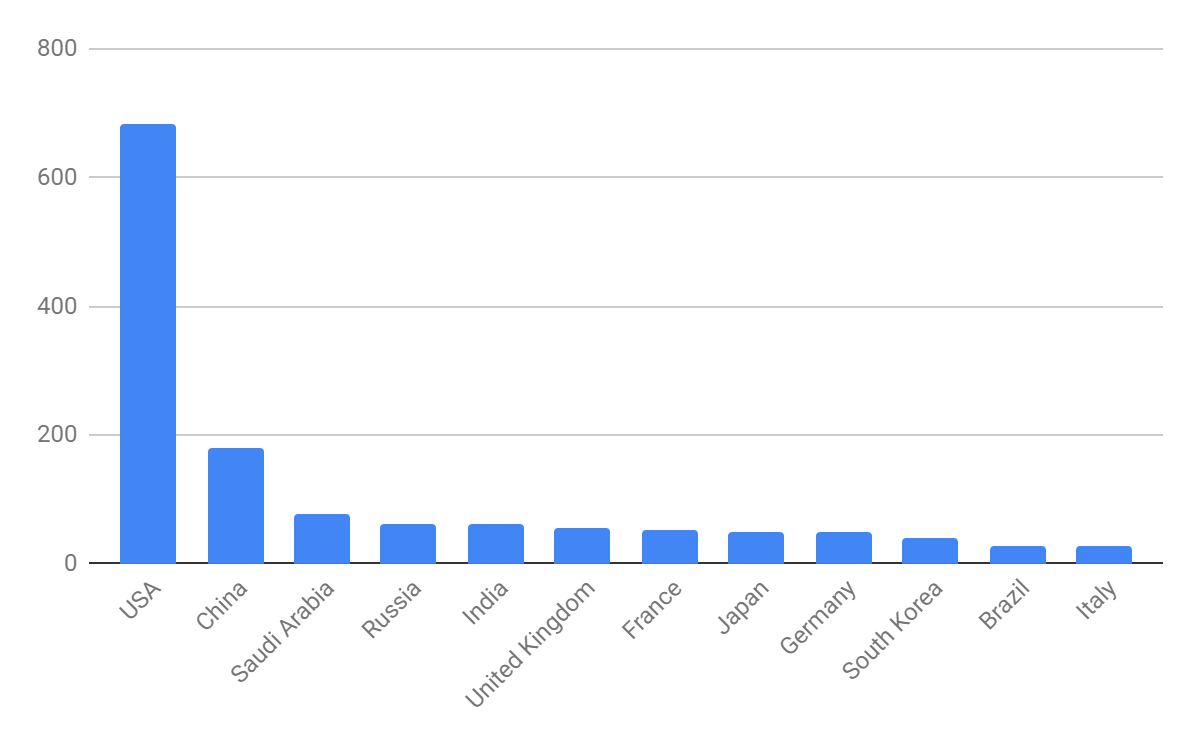
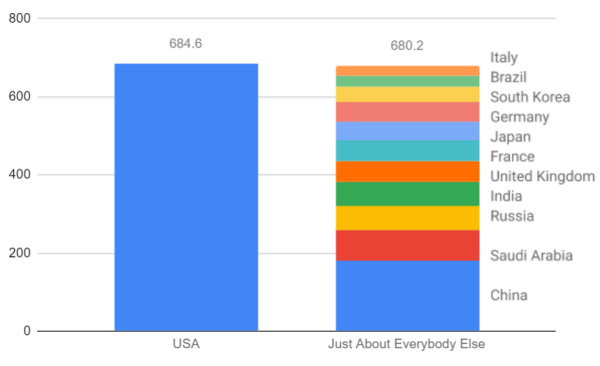
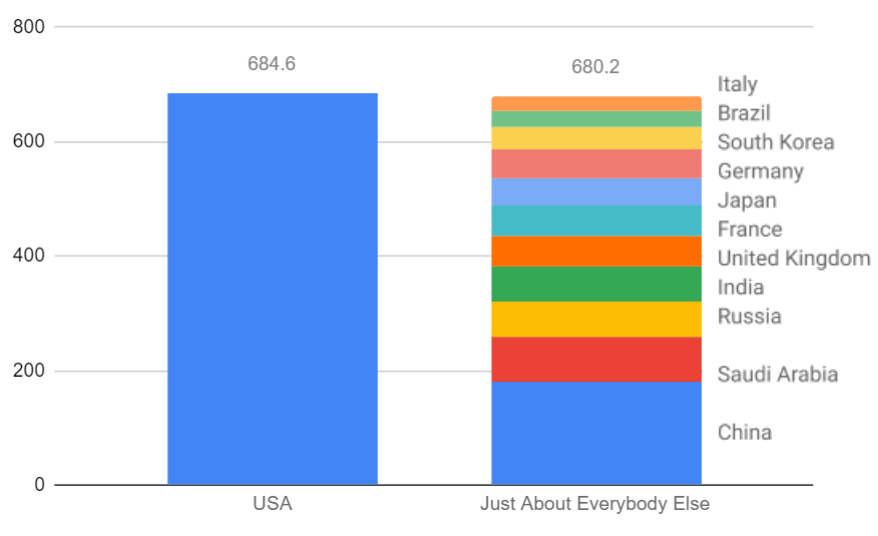
According to the 2020 edition of “The Military Balance” from the International Institute for Strategic Studies, the United States’ defense budget for 2019 was $684.6 billion. Currently we spend well over triple (almost quadruple) what China spends and over 8 times as much as Saudi Arabia. Those are the top two behind us! In fact, if you add up the next 11 highest national defense budgets, it would still be less than that of the United States. We’re talking about China, Saudi Arabia, Russia, India, the United Kingdom, France, Japan, Germany, South Korea, Brazil, and Italy COMBINED. That’s still $4 billion less than the United States spending. Some people may hear this and say hell yeah USA number 1 baby! And while that is a solid argument, I would float the idea that we might be spending an excessive amount of money on our military.

For reference, the top 12 military budgets by country in 2019:

  1. USA: $684.6 billion
  2. China: $181.1 billion
  3. Saudi Arabia: $78.4 billion
  4. Russia: $61.6 billion
  5. India: $60.5 billion
  6. UK: $54.8 billion
  7. France: $52.3 billion
  8. Japan: $48.6 billion
  9. Germany: $48.5 billion
  10. South Korea: $39.8 billion
  11. Brazil: $27.5 billion
  12. Italy: $27.1 billion

Below is the same information in a different graph:
So at the same time everyone is talking about how our country could possibly afford healthcare, social security, education, and other nice things, we’re raising our already astoundingly high military budget without batting an eye. On March 11, 2019, Trump sent Congress a proposed 2020 budget request of $750 billion for national security. The staggering amount of money our country spends on the military only makes sense if A) we’re planning on going to war with pretty much the rest of the world (I hope not) or B) people are getting very rich off that spending. Well, guess what, it’s B.

Companies like Lockheed Martin and Northrup Grumman make tons of money thanks to the United States military spending. In 2014, the CEO of Lockheed Martin made $33.7 million. If you’re wondering why we spend so much on our military compared to other countries, look no further than lobbying and campaign contributions. In 2012, defense contractors spent $132 million lobbying the federal government, and in the 2012 campaign cycle, defense contractors contributed over $27 million to candidates. So that seems to be the cycle. Defense contractors spend money on politicians to convince them to award huge contracts, which means we raise the defense budget, raise taxes, and bleed the American people dry in the name of “supporting our troops”. The politicians enact policies to take our money, they give that money to defense contractors, who spend it lavishly and pay their executives very well, and skim a little off the top to give back to the politicians so they can keep the cycle going. It’s a well-oiled machine. If you’re wondering why we’re constantly at war and why we have such a high defense budget, this might have something to do with it.

So…what if we stopped doing that? What if we lowered our military spending and started paying for stuff we actually need with that money? How much other stuff could we pay for?

Let me introduce you to my made up Democratic candidate. Let’s call her Senator Frankenstein because her policies are a combination of policies from current candidates and several candidates who have dropped out. And yes I know, Senator Frankenstein’s Monster would be a more accurate name, but whatever. 

Senator Frankenstein is running for president with the following policies (with the candidate it was taken from and the cost in parentheses): 

  1. Make significant infrastructure improvements (Sanders, $100 billion)
  2. Take money out of politics (Yang, $23 billion)
  3. Make college free and eliminate student loan debt (Warren, $125 billion)
  4. Give the average teacher a $13,500 raise (Harris, $31.5 billion)
  5. Improve the healthcare system (Buttigieg, $150 billion)
  6. Get to net zero emissions by 2050 (Biden, $170 billion)

In total, this would cost $599.5 billion per year. Once again, our defense budget in 2019 was $684.6 billion. Senator Frankenstein could pay for all of these nice things by decreasing the defense budget to $85.1 billion. Yes, that is below China’s budget, but China has more than 4 times as many people as the US does. Plus, we would have better healthcare for more people, net zero emissions by 2050, better paid teachers, free college, college loan forgiveness, better infrastructure, and a less corrupt political process. After all that, we would still be spending the second most of any country in the world on our military. That’s still more than Saudi Arabia or Russia. It’s even more than Germany and Italy combined. 

That’s all assuming that we Americans can be ok with being second place in something. Oh wait, we’re WORSE than second place in a LOT of things: income equality (105th), life expectancy (37th), education (24th), and happiness (19th). We also have more deaths from malnutrition than 63 other countries.

Why should we spend so much on our military, which goes into the pockets of ultra-wealthy defense contractors, when we could be making things so much better with that money? The simple answer is, we shouldn’t. It’s not right. It’s also not fair to the people in this country who have real problems. People who can’t drink the city water, people who don’t have homes, food, or healthcare. People who are in crippling debt, and who can’t afford an education. 

Even though you may not agree with the policies I wrote about in this article, I think we can all agree that there are a lot of better ways we could be using the crazy amount of money we have budgeted for the military. So think about that next time you vote, and don’t forget to vote for Frankenstein!

References:

  1. Significant infrastructure improvements: Sanders, $100 billion per year ($1 trillion over a decade)
  1. Taking money out of politics: Yang, $23 billion per year
  1. Free college for all and complete student loan debt forgiveness: Warren, $125 billion per year ($1.25 trillion over a decade)
  1. Boosting pay for all teachers: Harris, $31.5 billion per year ($315 billion over a decade)
  1. Improved healthcare system: Buttigeig, $150 billion per year ($1.5 trillion over a decade)
  1. Net zero emissions by 2050: Biden, $170 billion per year ($1.7 trillion over a decade)

War profiteering:

https://www.usatoday.com/story/money/2019/02/21/military-spending-defense-contractors-profiting-from-war-weapons-sales/39092315/

https://www.cnbc.com/2018/03/08/defense-ceo-salaries.html

Defense contractors influencing politics:

https://www.fool.com/investing/general/2013/11/02/top-5-defense-contractors-influencing-americas-pol.aspx

Why You Shouldn’t Get Excited About a Big Tax Return

You may have seen the new TurboTax commercial with a song that exclaims “all people are tax people” over and over (and over) again. The commercial aired during the Super Bowl and it features people from all walks of life dancing excitedly about getting their tax returns. If you haven’t seen it yet, don’t bother. You’ll wish you hadn’t. Besides the fact that the commercial features the most impossibly obnoxious song of all time, the thing that bothers me the most is the idea that people should hop out of their chairs and dance with joy whenever they receive a big tax return. Let’s make one thing clear. The key word in “tax return” is return. The government is returning your own money back to you because you overpaid your taxes throughout the year. They are giving you your own money. If you get a big tax return, that means you overpaid your taxes by a lot. And don’t count on the government to figure out how much you overpaid them. You have to figure that out, and if you’re wrong, it’s tax fraud, and you can get fined or sent to jail.

I get what Intuit (the company that makes TurboTax) is doing. They want to make tax returns seem like free money. They want tax returns to be exciting and fun so people will buy TurboTax to get as big of a return as possible. The message of the commercial is: “Hey, you can make thousands of dollars when you do your taxes! Isn’t that awesome? Let’s all dance and go crazy!”. To be fair, if there was any software that would guarantee me thousands of dollars instantly, I would download it right now. Who wouldn’t? The problem is, no matter how much Intuit wants you to think of it that way, a tax return isn’t free money.

To talk about tax returns, we really need to start with how taxes work in the United States. I specify the United States because once we start talking about how other countries do it, I think you’ll realize just how stupid our system is. Taxes work like this: imagine if you had a landlord who said “I’m not sure how much rent is, but you might be able to figure out how much you owe me if you read through this book of regulations that’s over 70,000 pages long. At the end of the year, if you overpaid me, you have to tell me how much I owe you back, and if you get it wrong I’m calling the cops.”

Taxes don’t have to be this complicated. In Japan for example, people don’t “do” their taxes. They just receive their tax return in the mail — already done for them. The United Kingdom and Germany do it the same way. Of course, citizens can look over their tax returns, find mistakes, and argue their case if they find anything wrong. In Sweden, New Zealand, Chile, Denmark, Spain, and Estonia the government populates the tax returns of their citizens for them, all the people have to do is look over it and submit it. Imagine that, imagine a world where you know how much you owe in taxes. Where it is simple and straightforward, and if you overpay, the government will just send you back the amount you overpaid with a simple explanation. This could easily be a reality, the IRS could do this because they know how much you owe every year, so they already have the numbers you use to file your tax return.

The reason we don’t have this, and honestly the reason we don’t have a lot of nice things, is because of lobbying. Yes, there are good uses for lobbying, but there are also a lot of bad uses. In fact, in some cases, it comes pretty close to downright bribery, and it definitely doesn’t always represent the interests of the American people.

You may think “well, at least we have good tax software that makes it easy”. This is exactly what companies like Intuit want you to think. Intuit has positioned itself to seem like a friendly company that will help you navigate the complications of the tax code for free. The fact is, not only are they not innocent, they are one of the main driving forces behind why the tax code is so complicated. Intuit has lobbied like crazy to keep the tax code complicated so that they can continue to sell their products. In the past decade (2010–2019), Intuit has spent just under $25 million on lobbying. $2.5 million of that was just in 2019.

I’m sure Intuit started out as a company with good intentions, but corporate greed took over at some point and they started caring less about the people they’re supposed to be helping and more about their own profits. Just like when tobacco was discovered to be extremely unhealthy, tobacco companies didn’t just back off and take the best interests of society into account. No, they doubled down on advertising, trying to make cigarettes cool instead of trying to make them seem healthy. That’s what Intuit is doing with TurboTax. They want taxes to seem fun, like you’re getting free money. They don’t want you to know how unnecessary it is for our taxes to be such a difficult mess, and they definitely don’t want you to know how they’re lobbying politicians behind the scenes to keep the tax code complicated.

Just to be clear, TurboTax definitely isn’t free either. They advertise it as free and then pull a switcheroo when you actually go to file your taxes. Seemingly random things will trigger the software to tell you to upgrade to the premium version to continue, and most people will do it. I’ve done it! When you’re filing your taxes, with a tax return of potentially thousands of dollars looming over your head, 80 bucks doesn’t seem that bad. When I say the return is “looming over your head”, it is literally one of the most obvious things on the screen. Your tax return is in giant green numbers at the top of the screen, like it’s a massive prize that you’ll get if you just shell out a little money. That carrot they’re dangling in front of you is your own money.

The reason Intuit has had to lobby so hard to keep taxes complicated is because there’s actually no good reason for them to stay complicated anymore. In an increasingly partisan society, this is a surprisingly non-partisan issue. Democrats, Republicans, and Independents all want a simpler tax code. But it’s not about what people want. It’s about how society perceives taxes. Intuit pays absurd amounts of money to control the narrative about taxes. They want you to think that taxes are just complicated, and there’s nothing we can do about it, as if that’s the way they’ve always been, and that’s the way they’ll always be. Intuit wants you to see them as your savior. They want you to think that they’re generously offering you TurboTax to help you with your troublesome taxes so you can get a bunch of free money.

In the grand scheme of things, the tax code being complicated is a pretty small issue compared to all of the problems facing our country, but that’s part of why it’s in that perfect sweet spot for Intuit to get away with it. If it were a bigger problem, everyone would be talking about it. As it is right now, it’s just a big enough problem to be annoying but not big enough for people to take action. That’s why they can get away with having a Super Bowl commercial with an annoying song where people are getting excited about doing their taxes and getting big tax returns. If the commercial were closer to real life, the people in it would be moaning about how awful the process of doing taxes is. They would be wondering why it seems like a total guessing game as to how much their tax return is going to be, or why sometimes instead of getting money back they actually owe money. The sad thing is, even knowing how bad Intuit is, I will probably still end up using it to do my taxes this year because they’ve positioned themselves in a place where I don’t know what else I could do. There are other tax programs, but most of them are just as much to blame for these issues. In fact, H&R Block spent over $3.7 million on lobbying in 2019.

The fact remains that change is possible. A simpler tax code is something that people want, and that is one great thing about this country. For better or for worse, when enough people want something in this country bad enough, they usually end up getting it.

P.S. By the way, if you want to see a good Super Bowl commercial, the one with Jason Momoa is actually hilarious. That is not an endorsement of the company running the ad. I just liked the commercial.

Image by Sally Jermain from Pixabay

Website Powered by WordPress.com.

Up ↑

Design a site like this with WordPress.com
Get started